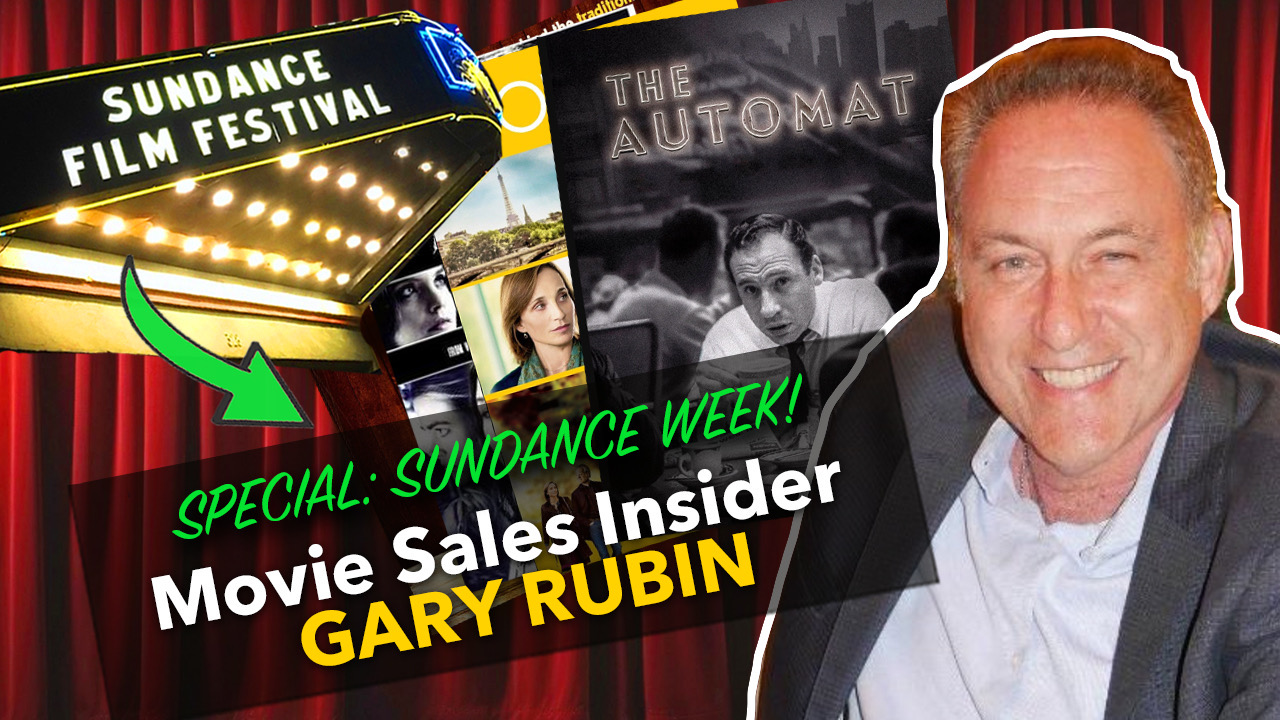
The Sundance Film Festival is back. And with the festival, we can expect stories in the news about the latest “big” acquisition of premiering films. But while the headlines focus on the acquisition price, we want to understand what’s going on beyond the number. How do these deals get done — and more importantly — what happens with the 99% of films that DON’T get picked up for distribution in a bidding war.

To learn more about how films get from production to distribution, we sat down with industry veteran Gary Rubin. In the go-go 90’s and early aughts, he was buying films at Artisan Entertainment, including being involved with the acquisition of THE BLAIR WITCH PROJECT. 

Later, he formed his own company, First Independent Pictures, handling the distribution of BIG FAN and HOLY ROLLERS.  

Lately, he’s switched to the other side, helping producers position their films for sale as a sales agent.  

And when buyers don’t bite, he’s ready to step in as a marketing consultant, guiding filmmakers through the process of self-distribution.

Making a film is a huge challenge. But in many respects, actually getting it in front of an audience is even tougher.  

So if you’re a filmmaker, or even just an interested consumer of independent films, you’ll want to listen in and learn more from our “inside baseball” conversation with Gary Rubin, on INSIDE THE ARTHOUSE… starting now.

As the Sundance Film Festival approaches its final year in Park City, we’re taking a moment to reflect on the artists who didn’t just pass through Sundance—but helped define it, and in doing so, shaped an entire era of American independent cinema.

Among those enduring icons is Steve Buscemi.

Buscemi’s breakthrough came with Bill Sherwood’s PARTING GLANCES, which premiered at Sundance in 1986. The film helped spark the New Queer Cinema movement and marked one of the earliest moments when Sundance revealed itself as a true launchpad for bold, deeply personal storytelling.

Throughout the late 1980s and 1990s, Buscemi became one of the most recognizable faces of independent film, collaborating with a generation of filmmakers who would go on to redefine the medium—including Joel and Ethan Coen, Quentin Tarantino, Jim Jarmusch, Abel Ferrara, and Tom DiCillo.

His unforgettable performance in Alexander Rockwell’s IN THE SOUP earned the film the Grand Jury Prize at Sundance in 1992, cementing Buscemi’s place at the heart of the indie film explosion of the ’90s.

More recently, Buscemi was honored by IndieCollect as part of their RescueFest 2025 program, recognizing his lasting impact on independent cinema and the preservation of film history.

For the occasion, IndieCollect founder Sandra Schulberg invited Greg to moderate a conversation with Steve, co-hosting alongside Michelle Satter, founder and longtime director of the Sundance Institute Labs.

We’re proud to bring that conversation to you now – this is Steve Buscemi in a Q & A format, on INSIDE THE ARTHOUSE— starting now.

Rebecca Zlotowski first caught our attention with her fifth feature, OTHER PEOPLE’S CHILDREN, which was released in the U.S. in 2023. So we were especially excited to screen her follow-up: A PRIVATE LIFE — a sleek, stylish French-language film that’s as entertaining as it is unexpectedly moving.

The film boasts a stellar cast led by Oscar-winner Jodie Foster and César-winner Daniel Auteuil, making it one of the most exciting cast-and-director pairings of the year.

In A PRIVATE LIFE, Foster plays a tightly wound psychiatrist whose carefully ordered world begins to unravel when one of her patients dies under mysterious circumstances. Blending mystery, romance, and comedy, it’s the kind of genre cocktail that shouldn’t work — but somehow does… and beautifully.

The result is a gripping, emotionally intelligent thriller with a real pulse, anchored by one of Foster’s most nuanced performances in years.

While this isn’t Foster’s first time acting in French, it may be her most accomplished — and the role has already made history, with Foster becoming the first American ever nominated for a César in an acting category.

To learn more about how the film came to be, we spent time with filmmaker Rebecca Zlotowski, and we’re thrilled to share that conversation with you.

Listen now to our episode on A PRIVATE LIFE with Rebecca Zlotowski — on INSIDE THE ARTHOUSE, starting now.

When a film earns a 100% rating on Rotten Tomatoes, there’s often a quiet suspicion that it’s a critic’s darling—admired more than embraced. But Charlie Polinger’s debut feature THE PLAGUE is something rarer: a film that marries the visceral pull of a taut thriller with the intelligence and moral urgency of serious arthouse cinema.

In this episode of INSIDE THE ARTHOUSE, we sit down with writer-director Charlie Polinger to discuss a film that has quickly become one of the most talked-about releases of 2025. Drawing from memories of his own pre-adolescence, Polinger crafts a story that feels deeply personal while speaking uncomfortably—and urgently—to the present moment. THE PLAGUE explores how casual cruelty, once confined to private spaces, has become increasingly normalized and even rewarded in public life.

The film premiered at Cannes, where it reportedly received an 11-minute standing ovation—an extraordinary response for a first feature led by a cast of unknown child actors. That reception wasn’t just about novelty. It was recognition of a filmmaker with a confident voice and a film that understands how to unsettle, provoke, and implicate its audience without sacrificing narrative momentum.
THE PLAGUE is tense, unsettling, and deeply felt—a debut that suggests Polinger is not only a director to watch, but one already operating with uncommon clarity and purpose.

To learn more about one of the most striking films of the year, join us for our conversation with Charlie Polinger—on INSIDE THE ARTHOUSE, starting now.


In THE TALE OF SILYAN — the highly anticipated follow-up to the Oscar-nominated documentary HONEYLAND— filmmaker Tamara Kotevska set out to explore how climate change is reshaping the migration patterns of storks in Macedonia. But over three years of filming, she and cinematographer Jean Dakar uncovered something far more expansive: an intimate portrait of global economic pressure, human migration, the unraveling of rural communities, and the fragile, deeply intertwined relationship between people, land, and wildlife.

What’s remarkable is how, at moments, THE TALE OF SILYAN plays like a narrative feature — yet nothing is staged. Every frame is real. And the story that unfolds is genuinely astonishing.

To dig into how this groundbreaking documentary came together — from early concept to final cut — we sat down with the film’s DP, Jean Dakar, for a conversation about craft, access, and capturing truth on camera.

That conversation on INSIDE THE ARTHOUSE, starting now…


They say journalism is the first rough draft of history—but what about films that confront historical events on screen? Are these works attempts at historical record or cinematic stories that use the past to uncover deeper emotional truths?

With her new film ALL THAT’S LEFT OF YOU, filmmaker Cherien Dabis brings a bold and deeply human perspective to a chapter of history rarely explored in American cinema. While the film depicts the Nakba and the 1948 expulsion from Jaffa, Dabis goes far beyond historical recreation—crafting a powerful emotional narrative that stands among the finest films of the year.

This sweeping, multigenerational epic follows one family across 70 years, tracing their journey from displacement during the 1948 war to life as refugees in the West Bank and beyond. Dabis stars in the film alongside three extraordinary actors from the renowned Bakri family—Adam Bakri, Saleh Bakri, and Mohammad Bakri—whose performances bring the family’s story to life with remarkable authenticity and depth.

After premiering to acclaim at the Sundance Film Festival, ALL THAT’S LEFT OF YOU went on to win the prestigious Audience Award at the Sydney Film Festival. The film has now been chosen as Jordan’s official submission for Best International Feature at the Academy Awards, and we believe it has every chance of making the year’s shortlist. To hear more about ALL THAT’S LEFT OF YOU, please sit back and enjoy our conversation with filmmaker, writer, and actress, Cherien Dabis, starting now on INSIDE THE ARTHOUSE

$7,000 might buy you a used car—but in Hollywood, it barely covers a single day of craft services on a studio film set.

But in the world of microbudget filmmaking, $7K became the entire production budget for filmmakers Joe Burke and Oliver Cooper, who used that tiny sum to create a full-length, truly independent feature film.

With a small crew, non-professional actors, shooting quickly, with a raw, natural shooting style, they crafted BURT— a miracle of sweetness and depth— a film that captures the spirit of classic indie cinema, echoing the charm of mumblecore pioneers like Andrew Bujalski, Greta Gerwig, and the Duplass Brothers.

Having wowed audiences at numerous film festivals, Joe and Oliver are channeling the Cassavetes playbook—and releasing BURT themselves into theaters.

On this episode of Inside the Arthouse, we wanted to talk to them about the inspiration for the film, their creative process, how they pulled off a feature on a shoestring budget, and the strategy behind bringing an independent film directly to audiences.

BURT is a small gem of a film, and Joe and Oliver are great examples of the indie spirit.

So if you’re dreaming of selling your car to make a movie—or want to learn how authentic independent films get made—you’ll want to start this episode right now… on Inside the Arthouse.

The New York Film Festival (NYFF) may not be the oldest film festival in the United States, but for more than 60 years, it has been one of the most influential, premiering some of the most important films and filmmakers in the history of cinema.  


From Luis Buñuel’s  THE EXTERMINATING ANGELthe opening night selection in 1963, to RaMell Ross’s NICKEL BOYS in 2024, the festival has consistently set the stage for awards season and marked the beginning of the race to the Oscars.

In this episode of INSIDE THE ARTHOUSE, we sit down with Dennis Lim, the festival’s Artistic Director and former film critic at the Village Voice, to discuss how the NYFF program is curated, what makes this event unique, and what audiences can expect from the 2025 New York Film Festival. Lim also shares insights on the broader programming of Film at Lincoln Center, one of the most vital institutions for independent and international cinema in the U.S.

Join us as we sit down with festival director Dennis Lim on INSIDE THE ARTHOUSE, starting now.


Writer and philosopher George Santayana wrote in 1905: “Those who cannot remember the past are condemned to repeat it.”

That idea has clearly inspired filmmaker Connie Field. Her award-winning documentaries on politics, history, and social change help us understand today’s world by drawing vital lessons from the past.

When women from the Baby Boom generation were entering the workforce, her groundbreaking film The Life and Times of Rosie the Riveter revealed the powerful stories of women who worked in World War II factories.

As voter suppression became a growing issue in parts of the U.S., her Oscar-nominated Freedom on My Mind reminded us of the importance of voting rights by documenting voter registration struggles in Mississippi during the 1960s Civil Rights Movement.

Now, Connie Field turns her lens to Europe—examining the election, defeat, and return to power of Viktor Orbán in Hungary.

The result is DEMOCRACY NOIR — a timely and chilling look at how democratic institutions can be weakened and reshaped into tools of authoritarian rule.

Democracy Noir is an urgent, important film. And we’re honored to share our conversation with Connie Field about the film—and about the state of democracy— on Inside the Arthouse, starting now…


Thank God for nature filmmakers. Sure, we could try to get ourselves out to some breathtaking wilderness. But would we really have the time—or the patience—to wait for a herd of elk to appear? Or the equipment to capture a shy family of beavers building a dam? And don’t even get me started on the vertigo that would stop me from watching a young condor soar above the Grand Canyon.

Thankfully, filmmaker Ben Masters and his team of cinematographers have done all of that for us. They’ve spent countless hours in the field, so that we can experience these wonders in under two hours—and for the price of a ticket.

THE AMERICAN SOUTHWEST is Masters’ third feature documentary, and it’s a stunning addition to his body of work. This time, he takes us along the mighty Colorado River, from its headwaters in the Rockies, through the Grand Canyon, and down to the Gulf of California. Along the way, we meet the signature species that call the river home, and we come to understand the delicate balance of this vital ecosystem.

The film not only helps us appreciate these creatures and landscapes, but also explores the impact we humans have on the river—and how we might become better stewards of our environment.

It’s a beautiful, meaningful film with something for audiences of all ages.

Join us now for our conversation with Ben Masters, Inside the Arthouse, starting now.